Home | Amazing | Today | Tags | Publishers | Years | Account | Search 
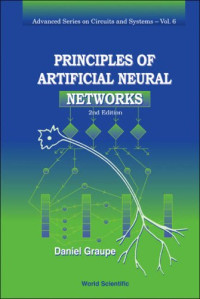
Principles of Artificial Neural Networks (Advanced Series in Circuits and Systems)

Buy
Artificial neural networks are, as their name indicates, computational networks which attempt to simulate, in a gross manner, the networks of nerve cell (neurons) of the biological (human or animal) central nervous system. This simulation is a gross cell-by-cell (neuron-by-neuron, element-by-element) simulation. It borrows from the neurophysiological knowledge of biological neurons and of networks of such biological neurons. It thus differs from conventional (digital or analog) computing machines that serve to replace, enhance or speed-up human brain computation without regard to organization of the computing elements and of their networking. Still, we emphasize that the simulation afforded by neural networks is very gross. Why then should we view artificial neural networks (denoted below as neural networks or ANNs) as more than an exercise in simulation? We must ask this question especially since, computationally (at least), a conventional digital computer can do everything that an artificial neural network can do.

The answer lies in two aspects of major importance. The neural network, by its simulating a biological neural network, is in fact a novel computer architecture and a novel algorithmization architecture relative to conventional computers. It allows using very simple computational operations (additions, multiplication and fundamental logic elements) to solve complex, mathematically ill-defined problems, nonlinear problems or stochastic problems. A conventional algorithm will employ complex sets of equations, and will apply to only a given problem and exactly to it. The ANN will be (a) computationally and algorithmically very simple and (b) it will have a self-organizing feature to allow it to hold for a wide range of problems.
(HTML tags aren't allowed.)

Cracking the Coding Interview, Fourth Edition: 150 Programming Interview Questions and Solutions

Now in the 4th edition, Cracking the Coding Interview gives you the interview preparation you need to get the top software developer jobs. This book provides:

* 150 Programming Interview Questions and Solutions: From binary trees to binary search, this list of 150 questions includes the most common and most useful questions
...

Artificial Intelligence: Foundations of Computational Agents

Recent decades have witnessed the emergence of artificial intelligence as a serious science and engineering discipline. Artificial Intelligence: Foundations of Computational Agents is a textbook aimed at junior to senior undergraduate students and first-year graduate students. It presents artificial intelligence (AI) using a coherent...

Advanced Qt Programming: Creating Great Software with C++ and Qt 4

This book is aimed at existing C++/Qt programmers and presents ideas and techniques that are too advanced or specialized (although not necessarily difficult), for a first book on Qt.

Qt has now grown to over 700 classes and well over a million words of documentation, far too much to cover in a single volume. So instead of
...


Professional Web Design: Techniques and Templates

This is the must-have book for designers who want to expand their skills and improve the quality of their designs. Learning CSS technology and continually improving one's design and developer skills is essential for every Web designer in today's marketplace. The goal of Professional Web Design: Techniques and Templates is to educate...

Linux Kernel Development (3rd Edition)

Linux Kernel Development details the design and implementation of the Linux kernel, presenting the content in a manner that is beneficial to those writing and developing kernel code, as well as to programmers seeking to better understand the operating system and become more efficient and productive in their...

Event Processing in Action

Unlike traditional information systems which work by issuing requests and waiting for responses, event-driven systems are designed to process events as they occur, allowing the system to observe, react dynamically, and issue personalized data depending on the recipient and situation.

Event Processing in Action...

©2010 LearnIT (support@pdfchm.net) - Privacy Policy